

IFFK should continue to be the Voice of the Voiceless: Abdullah Abu Shavesh
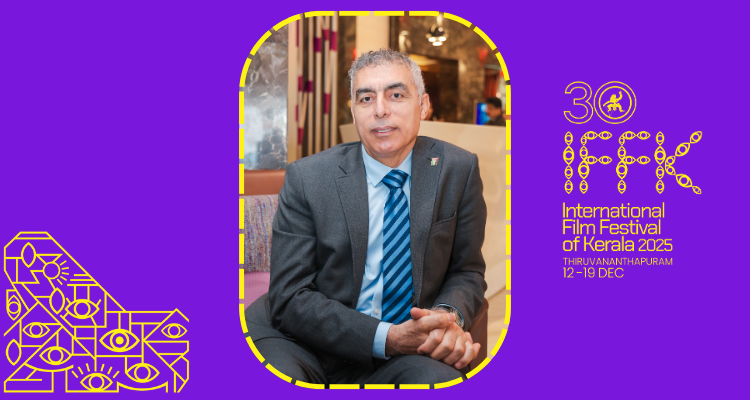
Palestine’s Ambassador to India, Abdullah Abu Shavesh, expressed deep appreciation for the opportunity provided by the 30th IFFK to screen films such as Palestine 36, which portray the lived realities of the Palestinian people and allow their stories to reach a global audience.
In an exclusive interview given on 13 December 2025, the Ambassador noted that for Palestinians, cinema is not merely an art form but a means of resistance and survival. Platforms like IFFK, he said, play a crucial role in amplifying voices that are otherwise silenced. “IFFK should continue to serve as a voice for the voiceless,” he asserted.
Regarding India’s role in the reconstruction and rehabilitation of Gaza, he praised the Indian government for its constructive engagement and support for the Palestinian people.
Drawing parallels between Indian and Palestinian histories, the Ambassador reflected on differing philosophies of resistance. He cited Mahatma Gandhi and Bhagat Singh as representing two distinct approaches. Bhagat Singh, he noted, was branded a terrorist by British colonial rulers, much like how those who resist illegal occupation are often portrayed today. He emphasized that Palestinian President Mahmoud Abbas follows Mahatma Gandhi’s school of thought—advocating peaceful, diplomatic, and legal resistance. “India’s history mirrors our present,” he remarked.
Highlighting the importance of IFFK as a cultural and political platform, Ambassador Abu Shavesh observed that Palestinians face severe restrictions in narrating their own stories. “IFFK gives us the space to explain why this happened, how it happened, and the history behind it,” he said. He also pointed out that even on social media, content related to Palestine is frequently censored.
Addressing the challenges faced by Palestinian filmmakers, the Ambassador stated that Israeli occupation remains the greatest obstacle. Filmmakers are often denied permission to shoot within Palestine and face the risk of arrest even for making documentary films. “People can be arrested for filming—or even for posting a tweet,” he said, underlining the harsh realities confronting Palestinian artists.
He praised Kerala’s commitment to peace, justice, and international law, noting that the festival’s significance was underscored by the fact that its inaugural film itself begins with the word ‘Palestine’.
Download Mobile Apps: